


Understanding the Core Focus: Casual Habits vs Goal-Driven Fluency
When comparing Wissero vs Duolingo, the fundamental difference lies in learning philosophy: building a casual daily habit versus achieving measurable, real-world fluency.
Duolingo revolutionized language learning accessibility through gamification. Its bite-sized micro-lessons, streak counters, and reward loops excel at keeping learners engaged and introducing basic vocabulary. For casual learners looking to spend five minutes a day refreshing basic phrases, it serves as an entertaining entry point.
However, maintaining a 300-day streak does not automatically translate into the ability to navigate a professional interview or pass an accredited exam.
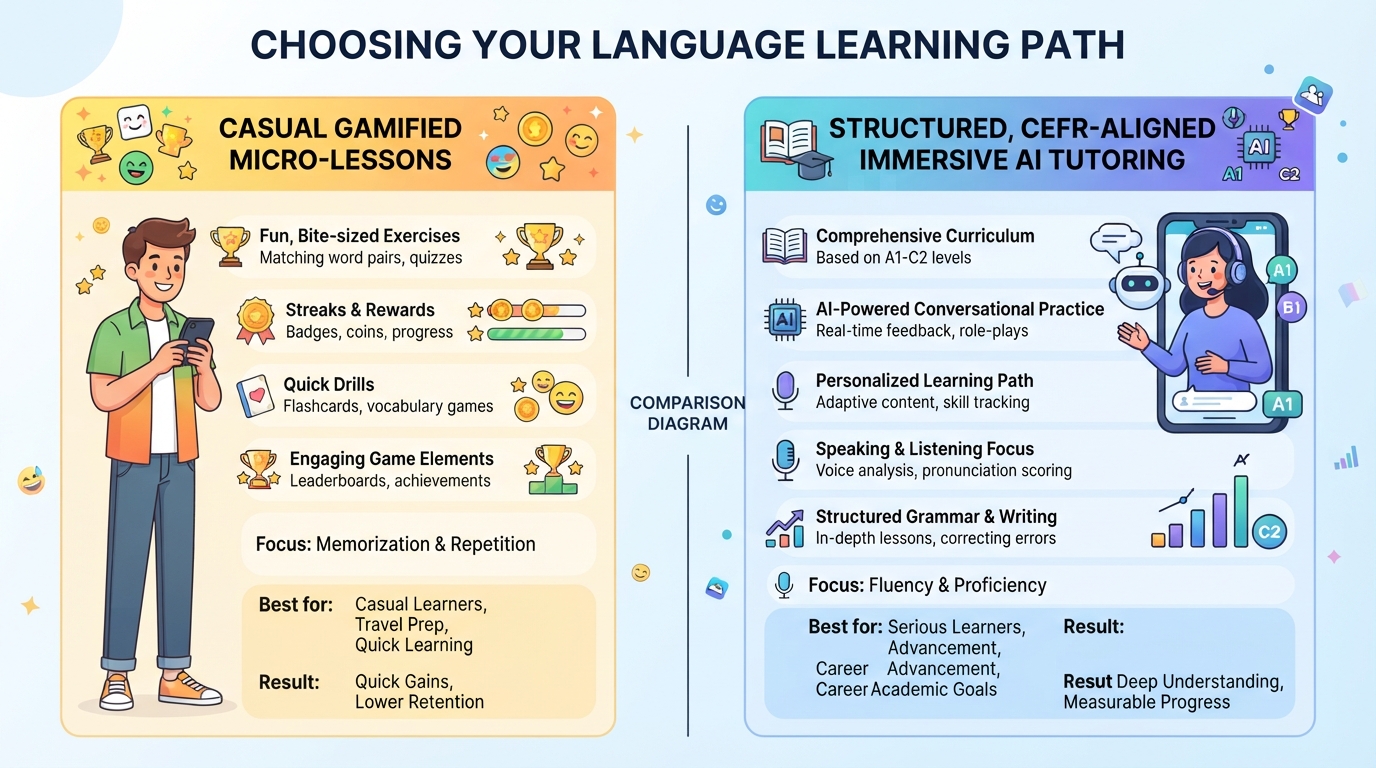
Wissero takes a fundamentally different approach. Engineered specifically for university students, ambitious professionals, and serious learners, Wissero shifts the focus from simple gamified retention to structured, outcome-oriented mastery. Instead of isolated word matching and repetitive drills, Wissero centers its curriculum on the Common European Framework of Reference for Languages (CEFR), guiding users systematically from foundational levels (A1–A2) to independent and proficient fluency (B1–C1).
The Shift from Streaks to Measurable Mastery
Achieving functional language proficiency requires moving beyond gamified metrics to immersive, practical application:
Curriculum Alignment: Duolingo relies on proprietary skill trees that emphasize rote memorization. Wissero aligns directly with international CEFR benchmarks, ensuring that every lesson contributes to recognized linguistic milestones.
Contextual Application: While quick exercises teach isolated vocabulary, Wissero places learners in dynamic, real-world scenarios designed to develop spontaneous conversational competence and professional communication skills.
Outcome Orientation: Duolingo optimizes for daily app engagement; Wissero optimizes for tangible progress, helping learners prepare for international language certifications, academic study abroad, and global career opportunities.
Key Takeaway: Casual gamification is effective for habit formation, but structured, CEFR-aligned training is essential for true professional fluency.
For learners who have outgrown matching games and require verified proficiency for their academic or career goals, the shift from gamified streaks to structured AI-driven tutoring marks the turning point in their language journey.
Curriculum Structure: Gamified Drills vs CEFR-Aligned Progression
Understanding the structural differences in the Wissero vs Duolingo debate comes down to one core question: are you studying for entertainment, or are you training for measurable fluency?
Duolingo: Micro-Lessons and Translation Drills
Duolingo builds its curriculum around bite-sized, thematic "units" filled with gamified mechanics: word banks, drag-and-drop matching, and isolated sentence translation. While this format excels at lowering the barrier to entry, it creates distinct learning bottlenecks:
Fragmented Context: Translating disconnected, absurd sentences ("The green bear drinks milk") fails to prepare learners for nuanced, real-life discourse.
Over-Reliance on Recognition: Multiple-choice drills test passive recall rather than active, spontaneous language production.
Arbitrary Milestones: Progress is measured through proprietary "crowns" and streaks rather than globally validated fluency benchmarks.
Wissero: Systematic, CEFR-Aligned Mastery
Serious language goals—such as passing the DELE, DELF, or Goethe-Zertifikat, enrolling in an international university, or working abroad—require a deliberate, standardized roadmap.
Wissero abandons repetitive matching games in favor of a structured CEFR-aligned learning path (A1 to C1). Instead of isolating grammar mechanics, Wissero integrates structural rules directly into deep contextual dialogues, authentic cultural scenarios, and complex professional environments.
A1–A2 (Foundational): Master core functional grammar and practical survival dialogues with contextual AI guidance.
B1–B2 (Independent): Formulate spontaneous arguments, navigate complex workplace interactions, and comprehend native-speed discourse.
C1 (Proficient): Refine stylistic nuance, advanced idioms, and high-level academic writing.
Key Takeaway: Casual translation drills build basic vocabulary recognition, but only a rigorous CEFR-aligned framework builds the structural competence required for verified fluency.
Through a dedicated academic study space, Wissero provides structured grammar breakdowns, real-time error analysis, and intentional study modules. This systematic approach ensures every minute invested directly advances your functional language proficiency.
Study Environments: Quick Mobile Micro-learning vs Deep Study Spaces
The debate between Wissero vs Duolingo often comes down to the environment in which you learn best. Duolingo champions the micro-learning model, engineering bite-sized, five-minute lessons designed for quick commutes, waiting rooms, and casual daily engagement. While this structure excels at maintaining basic daily habits, it fractures focus, making it nearly impossible to develop the sustained concentration needed for complex language acquisition.
True fluency—especially for university students and professionals aiming for CEFR certification (B2–C1)—demands a transition from casual taps on a screen to structured, deep-work environments.
Why Deep Language Acquisition Demands More
Mastering advanced syntax, technical vocabulary, and professional communication requires integrated study tools that mirror real-world language tasks:
Document Analysis: Engaging with authentic long-form texts, academic papers, and industry reports rather than disconnected, gamified sentences.
Active Writing Practice: Formulating structured essays, business correspondence, and complex arguments with immediate structural feedback.
Centralized Knowledge Systems: Organizing contextual vocabulary, grammar rules, and personal notes in one cohesive study space.
Elevate Your Practice with Wissero's StudyLab
To bridge the gap between casual practice and academic rigor, Wissero introduces StudyLab—a dedicated study space built for deep language immersion.
Within Wissero StudyLab, learners move far beyond surface-level drills:
Analyze Complex Texts: Upload, dissect, and annotate authentic source materials while the AI clarifies idioms, regional nuances, and advanced grammatical structures in real time.
Comprehensive Writing Workbenches: Draft long-form responses and receive instant, in-depth critiques on tone, coherence, and lexical variety.
Integrated Study Management: Seamlessly organize customized vocabulary decks, grammar notes, and AI-generated study guides tailored directly to your professional or academic goals.
Key Takeaway: Five-minute mobile games are great for passing the time, but professional and academic mastery requires dedicated, deep-study study spaces designed for complex text analysis and structured production.
Choosing between micro-learning and deep study comes down to your ultimate intent. If your goal is light, conversational familiarity, casual mobile apps fit the bill. But if your objective is professional mobility or academic success, Wissero provides the robust infrastructure needed to achieve genuine language mastery.