

The Rise and Limits of AI Chatbots in Education
The emergence of large language models like ChatGPT and Google Gemini fundamentally disrupted self-directed learning. Almost overnight, AI chatbots in education eliminated the traditional barriers to speaking practice. Learners no longer needed expensive private tutors or native-speaking conversation partners to practice a target language; infinite, on-demand dialogue became accessible 24/7 at the tap of a screen.
However, as the novelty fades, a fundamental limitation has surfaced: generic LLMs are conversational engines, not pedagogical systems.
Standard AI tools operate strictly on open-ended prompting. While they can simulate human-like banter across thousands of topics, they lack the foundational instructional design necessary for structured mastery. When you open a blank chat interface, the entire cognitive burden of structuring the lesson falls on you.
This creates the paradox of choice in digital learning:
Aimless small talk: Without a defined syllabus, practice sessions default to superficial pleasantries ("How is the weather today?") rather than targeted skill acquisition.
Lack of scaffolded progression: Generic bots rarely track long-term competency, meaning they cannot systematically reinforce weak vocabulary or progressively increase grammatical complexity.
Passive correction: Standard models often prioritize conversational flow over error correction, letting subtle mistakes solidify into bad habits unless explicitly prompted to intervene.
Key Takeaway: Unconstrained conversational practice does not equal deliberate practice. Fluency requires systematic progression, targeted feedback, and pedagogical structure—three things a blank prompt box cannot provide on its own.
For motivated students and educators alike, unstructured chatting quickly leads to a learning plateau. To move from casual conversation to measurable proficiency, AI must be paired with structured learning frameworks rather than left to open-ended improvisation.
Freeform Chat vs. Pedagogical Structure in Language Acquisition
True language acquisition is not a byproduct of infinite dialogue; it is the result of deliberate, structured practice. While open-ended AI chatbots in education excel at simulating casual conversation, they fundamentally lack the pedagogical architecture required to build lasting fluency.
Mastering a new language requires three non-negotiable instructional pillars:
Scaffolded difficulty: Gradually advancing from simple syntactic structures to complex discourse.
CEFR alignment: Benchmarking progress against standardized competency levels (A1 to C2).
Spaced repetition: Systematically reintroducing vocabulary and grammar rules right before cognitive decay occurs.
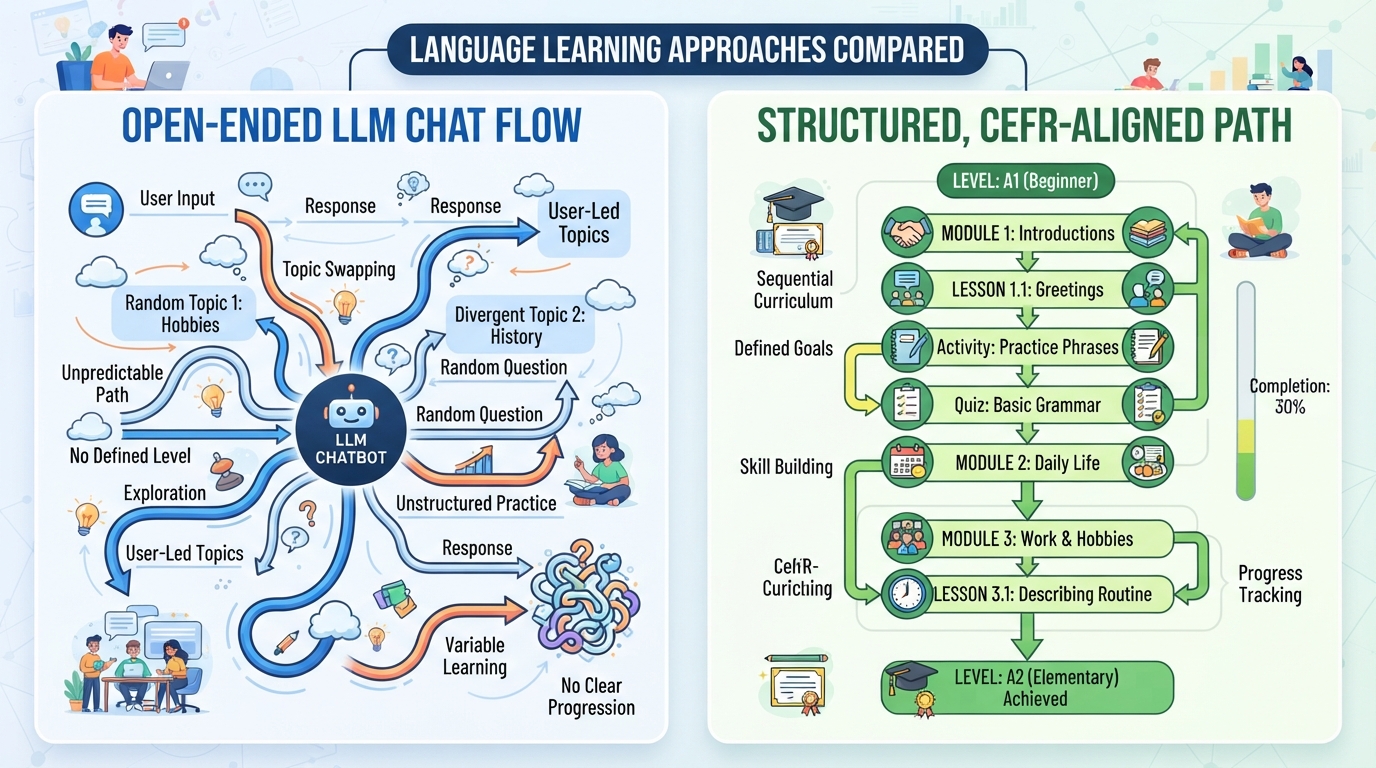
Standard chatbots operate on reactive prompts rather than proactive instruction. If you make a subtle conjugation error during a freeform chat, a generic LLM will typically ignore it to keep the conversation flowing smoothly. It cannot track historical error patterns, diagnose persistent grammatical deficits, or measure longitudinal fluency gains. You are left practicing what is comfortable rather than what is necessary.
Standard Chatbots:  Prompt ──► Reactive Reply ──► Unmonitored Drift (No Mastery)
Structured EdTech:  Input  ──► Error Diagnosis ──► Scaffolded Intervention ──► CEFR Progression
Key Takeaway: Unstructured chatting creates the illusion of competence. Without targeted error intervention and progressive difficulty, learners plateau quickly in conversational comfort zones.
Moving from Aimless Talk to Measurable Proficiency
This pedagogical gap is precisely where Wissero bridges the divide between conversational AI and intentional learning. Instead of dropping you into an aimless, blank chat window, Wissero implements dynamic, CEFR-aligned learning paths tailored to your real-time performance.
Wissero replaces passive chatting with structured pedagogical guidance:
Targeted grammar interventions: Identifying recurring mistakes in syntax and immediately serving micro-drills to correct them.
Adaptive vocabulary scaffolding: Automatically weaving targeted lexicon into context-rich dialogues based on your spaced repetition schedule.
Objective progress metrics: Providing actionable analytics on grammatical accuracy, lexical diversity, and milestone completion.
By anchoring conversational practice to proven instructional design, learners gain the dynamic freedom of AI dialogue backed by the rigorous progression of a world-class curriculum.
Choosing the Right AI Tool for Measurable Learning
Generic AI chatbots in education often promise effortless fluency, but open-ended text prompts rarely translate into measurable skill acquisition. Without pedagogical structure, conversational practice quickly turns into superficial chatter that fails to build durable language proficiency.
To achieve tangible, long-term learning outcomes, students and educators must look beyond standard chatbot interfaces and evaluate specialized educational platforms using a clear framework.
The Educational AI Evaluation Checklist
When selecting an AI-powered language platform, prioritize tools that replace open-ended prompting with intentional learning architecture:
Structured Curriculum Alignment: Ensure the system guides learners through systematic progression frameworks (such as CEFR levels) rather than relying on user-driven prompts that leave critical knowledge gaps.
Objective Progress Tracking: Look for actionable analytics that measure communicative fluency, vocabulary acquisition, and grammatical accuracy over time, rather than vanity metrics like message counts.
Cognitive Retention Architecture: The tool must incorporate evidence-based learning mechanisms, such as spaced repetition, contextual retrieval, and immediate formative feedback, to prevent fossilized errors.
Multimodal and Social Scaffolding: Prioritize interfaces that simulate realistic, face-to-face communication through audio and visual cues to strengthen conversational recall and lower speaking anxiety.
Key Takeaway: Open-ended chatbots respond to inputs, but dedicated learning environments actively guide cognitive development. Measurable fluency requires pedagogical structure, real-time error correction, and systematic progression.
Move Beyond Static Prompts with Wissero
Moving from unstructured chat boxes to an intentional learning system is essential for lasting mastery. Wissero bridges this gap by replacing unpredictable prompt engineering with a scientifically grounded educational environment.
By integrating embodied 3D interactions with structured, level-appropriate curricula and real-time adaptive feedback, Wissero ensures every conversational exchange directly builds measurable proficiency.
Experience the difference that structured, immersive language acquisition makes. Step into Wissero to transform unstructured practice into verifiable fluency.